By
By It is estimated that the flooring and carpets market is projected to grow in a steady manner between 2025-2035 due to the growing number of home improvement projects, the growth of commercial development, the growing demand for environmentally friendly products and the constant technological advancements in flooring.
As American business and customers search for long-lasting designs and durable products, a new age of innovation is expected to begin in the flooring industry.
The report is focused on the flooring and carpets market outlook from 2025 to 2035, examines how big the market is, drivers and the emergence of technology trends, issues and potential future developments.
Flooring and Carpets Market Size & Growth Forecast (2025–2035)
Recently, market studies have revealed the market worldwide for flooring and carpet is expected to increase to 327.2 billion dollars by 2025.
It will reach 327.2 billion in 2025. up to 533.0 billion in 2035. 533.0 billion by 2035 with a CAGR of 5.2 percent .
In this rapidly growing market North America and specifically particularly the United States is one of the largest and most important markets, caused by home renovations infrastructure investment, as well as the demand for eco-friendly flooring choices .
In particular, and more specifically, the United States flooring market is expected to expand from US$ 23.19 billion in 2025, and 34.66 billion by 2035. This is accompanied by an estimated 4.10 percent CAGR. This is supported by eco-certified house improvements, renovations to homes flooring, as well as commercial infrastructure expansion .
As of now it is estimated that the U.S. carpet market predicted to expand by 13.8 billion dollars by 2025. It will then increase to USD 29.5 billion by 2035.
This will result in the highest 7.9 % CAGR, which is a sign of the growing commercial and residential demands for carpets.
Read More: Career Opportunities in the Global Carpet and Textile Industry
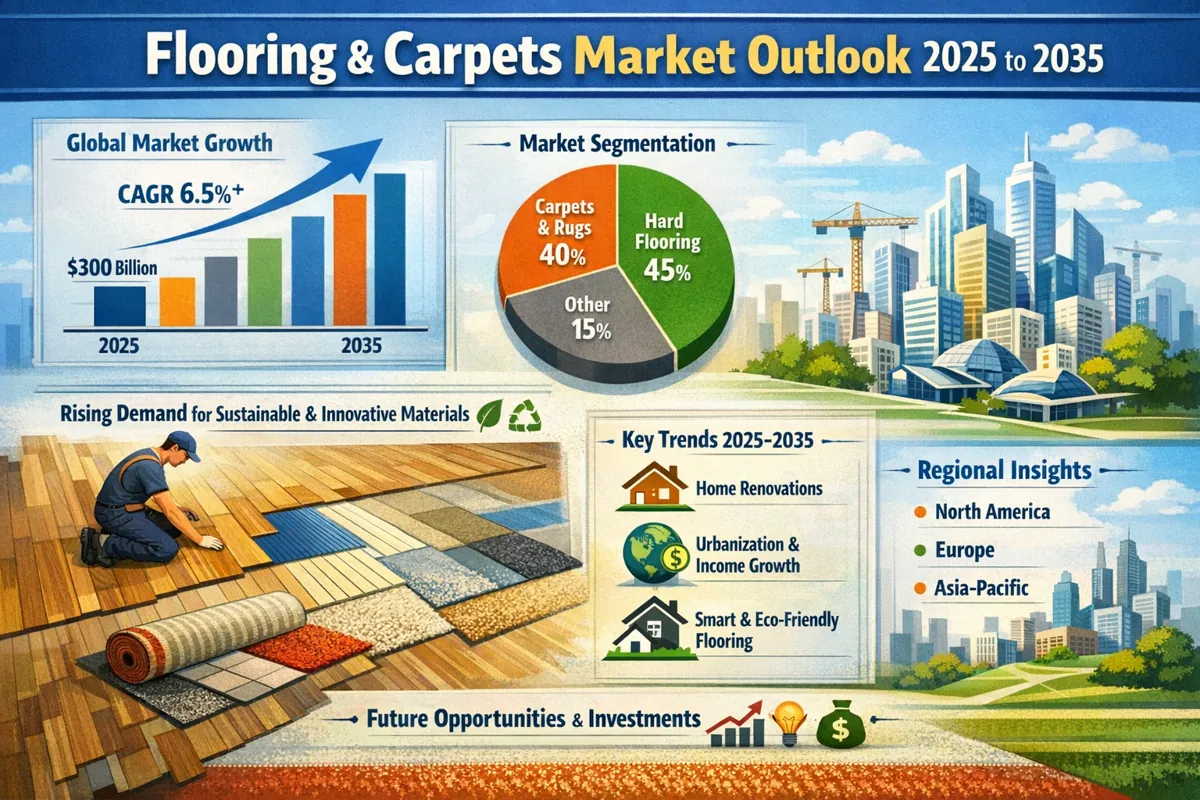
Key Growth Drivers in the US Flooring and Carpets Market
1. Home Renovation and Remodeling Boom
An increase in renovations to homes all across the U.S. is among the biggest growth factors. homeowners are resurfacing flooring in their kitchens, basements, living rooms as well as rental homes, preferring elegant, durable and affordable flooring .
2. Commercial Construction & Infrastructure Investment
Federal and state infrastructure investments–including projects tied to the Infrastructure Investment and Jobs Act–are boosting flooring demand in schools, hospitals, offices, retail spaces, and public buildings .
3. Sustainability & Eco-Friendly Flooring Demand
American consumers are increasingly drawn to:
- Flooring with low-VOC to improve indoor air quality
- Materials that are renewable and recycled
- Carpets and flooring that are certified green
Manufacturers are responding by implementing eco-friendly manufacturing processes and circular economic models, which are improving the sustainability of their products and gaining brand recognition .
4. Demand for Luxury & Designer Flooring
Premium flooring segments, such as luxurious vinyl tile (LVT) hardwood designer carpets, custom flooring–are rising due to increased rising demand from luxurious residential hospitality, corporate, and residential projects.
Read More: Future of Carpet and Textile Industry in India
Major Flooring & Carpet Trends in the USA (2025-2035)
Sustainable & Green Flooring
Sustainability remains a major trend. Developers and consumers alike prefer bio-based and recycled carpets, flooring, as well as environmentally responsible manufacturing. Sustainable flooring adoption is predicted to rise at the rate of double-digits in the coming years.
Luxury Vinyl Tile (LVT) & Resilient Flooring Growth
LVT along with SPC flooring are gaining popularity because of:
- Water resistance
- Easy to maintain
- A realistic stone and wood aesthetic
- Cost effectiveness
These materials are very sought-after in the renovation-driven U.S. housing markets .
Smart Flooring & Technology Integration
Innovation drives the creation of:
- Smart flooring solutions
- Antimicrobial carpets
- High-performance stain-resistant, high-performance fibers
- Printing digitally and custom designs
Companies are investing heavily in artificial intelligence-driven tools for design as well as automation of production to meet changing expectations of the consumer.
Read More: History of Kashmiri Hand-Knotted Carpets
Textured, Natural & Warm Design Aesthetics
U.S. flooring trends for 2026 and beyond highlight:
- Natural wood tones and warm neutrals
- Wide plank flooring
- Textured finishes
- Carpets with soft, plush padding and rug
The flooring trend is gaining popularity among consumers because it can provide ease of use as well as visual depth as well as natural beauty.
Carpet Market Outlook in the United States
Carpet is a prominent flooring type throughout the U.S., particularly in living rooms, bedrooms as well as offices and hospitality areas.
The U.S. carpet market is predicted to expand to USD 21.33 billion by 2024, and reach USD 32.97 billion by 2033. This is an 4.96 percent CAGR, due to:
- Renovations to homes
- Commercial expansion
- The demand for eco-friendly and stain-resistant carpets
Furthermore, polyester carpets dominate in terms of material share and carpets tufted make up more than 68 percent in U.S. carpets sold which reflects the need for durability and affordability .
Consumer Preferences in the US Flooring Market
American consumers value:
- Long-lasting durability and longevity
- Simple maintenance, cleaning and care
- Sustainability and eco-certifications
- Design and aesthetic appeal versatility
- Modular flooring and customization options
There is also a growing need for flexible carpet tiles that allow for an incredibly flexible design, quick replacement, and high cost efficiency in commercial settings.
Competitive Landscape & Key Industry Players
The U.S. flooring and carpets market is highly competitive, with leading brands focused on the latest technologies, sustainability, and multichannel plans for retailers.
Some of the major companies are:
- Mohawk Industries
- Shaw Industries
- Interface
- Armstrong Flooring
- Tarkett
- Milliken
These firms have invested on digitization, reused materials and premium products to remain in the game .
Challenges Facing the Flooring & Carpet Industry
Rising Raw Material & Logistics Costs
The fluctuating prices of wool, petrochemicals, vinyl and wood affect profitability and price stability.
Competition from Hard Surface Flooring
Carpets are in fierce competition with tiles, hardwood laminate, LVT and other flooring materials particularly in commercial and residential areas .
Labor Shortages & Manufacturing Costs
U.S. manufacturers face increasing cost of labor and worker shortages and automation investment is a major driver .
Regulatory & Environmental Compliance
Environmental standards that are more stringent require constant improvement in sustainable production methods and low emission materials .
Opportunities & Future Growth Areas (2025-2035)
The biggest prospects for U.S. flooring and carpets market are:
Eco-Friendly & Recycled Flooring Expansion: The need for eco-friendly flooring as well as circular models of production is predicted to grow.
Smart Homes & IoT-Enabled Flooring: The integration of technology for smart homes creates new product possibilities.
Luxury & Custom Flooring: A growing interest in custom flooring, high-end carpets and designer collaborations.
Commercial & Hospitality Growth: Offices, hotels as well as healthcare facilities and retail space will continue to drive the demand.
E-Commerce & Digital Retail Growth: Carpet and flooring sales online are rising, increasing access and transparency of prices .
Future Outlook: US Flooring & Carpets Market Through 2035
The U.S. flooring and carpets market outlook from 2025 to 2035 is positive which is supported by
- Continuous house renovations
- Expanding of infrastructure and commercial projects
- Growing environmental-consciousness in consumer behavior
- Innovative design in innovative durable, long-lasting, and sustainable flooring materials
Flooring continues to evolve beyond its function to become an sustainable, design and a technology-driven industry businesses that focus on the latest innovations, environmental responsibility and a customer-centric approach to design will be the leaders in the coming decade of expansion.